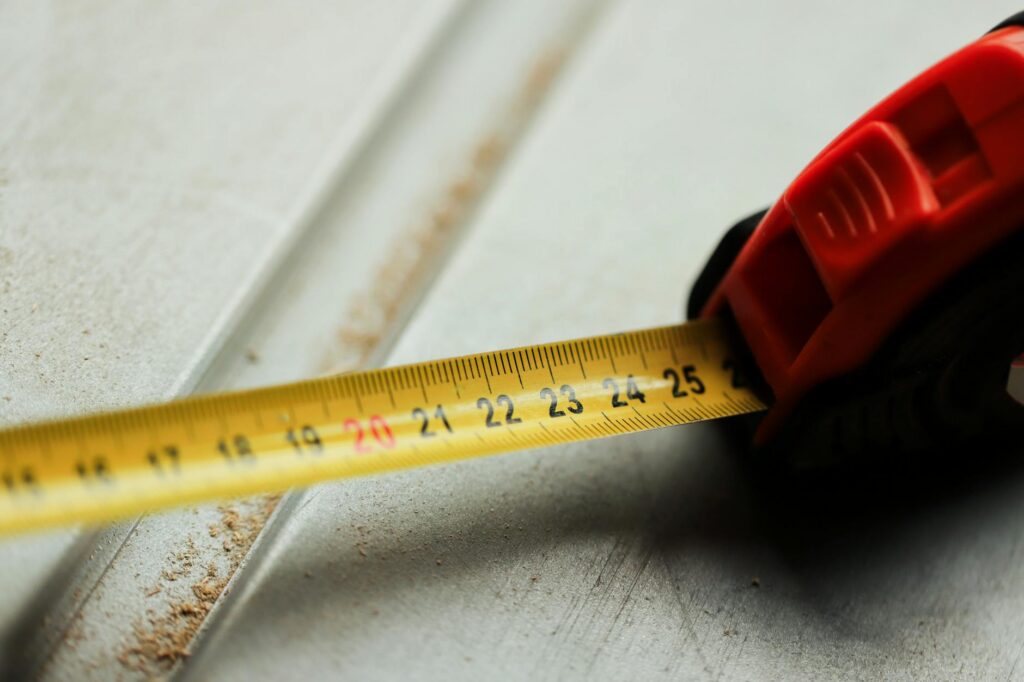
Accurate measurements are essential for buying the right amount of paint and avoiding costly mistakes. By measuring your walls, trim, and ceilings correctly, you’ll know exactly how much paint you need and can complete your project efficiently. This guide walks you through the proper techniques for measuring every surface in your home.
Measuring Wall Square Footage
Wall measurement is straightforward but requires attention to detail. Start by measuring the height of your walls from floor to ceiling using a tape measure. Most standard residential ceilings are 8 feet, but always verify yours as some can be 9 or 10 feet. Write this number down.
Next, measure the length of each wall horizontally. If you’re measuring a room with four walls, measure each one individually rather than assuming they’re equal. Some walls may be slightly different lengths due to architectural features or room layouts. Add all the wall lengths together to get the total linear footage around the perimeter.
Multiply the total perimeter by the wall height to get your total wall square footage. For example, if your room’s perimeter is 40 feet and ceilings are 8 feet high, your total wall area is 320 square feet. However, you’ll need to account for doors and windows, which typically don’t need painting.
Subtract window and door openings from your total. A standard door is about 21 square feet (3 feet wide × 7 feet tall), while an average window is roughly 15 square feet. Add these up and subtract from your total wall square footage. This gives you the actual paintable wall area.
Measuring Trim and Baseboards
Trim and baseboards require a different measurement approach since they’re linear rather than square. Measure the total linear footage of all trim you plan to paint. This includes baseboards, crown molding, chair rail, or any other trim elements.
For baseboards, measure along the bottom of every wall where baseboards exist. Again, measure each wall individually and add them together. Most baseboards are 3.5 inches wide, so you’ll need less paint than you would for full walls.
When calculating trim coverage, you need to know the width of your trim. Most standard baseboards are 3.5 to 5.5 inches wide. Multiply your total linear footage by the width (converted to feet) to get square footage. For example, 100 linear feet of 4-inch-wide baseboards equals approximately 33 square feet.
Don’t forget about interior corners, door frames, and window casings. These small areas add up and should be included in your trim measurements. If you have elaborate crown molding or decorative trim, measure carefully as these pieces may require more paint due to their texture and surface area.
Measuring Ceiling Square Footage
Ceiling measurements are among the easiest since most ceilings are simple rectangles. Measure the length of your room and the width of your room, then multiply these two numbers together. If your room is 15 feet long by 12 feet wide, your ceiling is 180 square feet.
For rooms with vaulted or cathedral ceilings, things get more complex. Measure the base width and the peak height, then use the formula for a triangle if the ceiling comes to a point. If your vaulted ceiling runs the length of the room, divide it into sections and calculate each part separately.
Textured ceilings require additional paint beyond smooth surfaces. Textured ceilings can absorb 10-20% more paint due to their irregular surface. If you’re painting a textured ceiling, increase your paint estimate by this amount to ensure you have enough.
For popcorn ceilings or heavily textured surfaces, consider requesting paint coverage information from the manufacturer. These surfaces are unpredictable and may require more paint than standard calculations suggest. When in doubt, it’s better to buy slightly more paint than to run short mid-project.
How to Use the Calculator
Once you have all your measurements, use the paint calculator to determine exactly how much paint you need. Simply input your wall square footage, trim linear footage, ceiling square footage, and the number of coats you plan to apply. The calculator accounts for standard paint coverage rates (typically 350-400 square feet per gallon) and provides precise recommendations.
The calculator helps you avoid overbuying or underbuying paint. Since paint is often sold in gallons or 5-gallon buckets, knowing your exact needs prevents waste and saves money. It also factors in whether you’re using primer, which requires similar calculations but may have different coverage rates.
Frequently Asked Questions
Do I need to measure around electrical outlets and light switches?
No, electrical outlets and light switches are too small to affect your paint calculations meaningfully. The area around a standard outlet or switch is only about 2-3 square inches. With hundreds or thousands of square feet to paint, these minor deviations don’t impact paint quantity. Simply measure your walls as complete rectangles and ignore these small openings.
How much extra paint should I buy for mistakes or touch-ups?
Purchase an additional 10% more paint beyond your calculated amount for mistakes, spills, and future touch-ups. If the calculator recommends 3 gallons, buy 3.3 gallons (rounding to 3.5 gallons since that’s a common size). Paint oxidizes and changes slightly over time, so having leftover paint from the original batch ensures perfect color matching for future repairs. Store unused paint in a cool, dry place for years.
Does room shape affect how much paint I need?
Room shape doesn’t significantly affect paint quantity as long as you measure accurately. Whether your room is square, rectangular, L-shaped, or has unusual angles, the calculation remains the same: measure each wall and multiply by height. Irregular shapes simply require more individual wall measurements. Add up all sections and use the total square footage with the paint calculator for accurate results.
- Digital Tape Measure — Essential tool for accurately measuring walls, trim, and ceilings before painting; directly supports the core topic of the post
- Paint Calculator App/Tool Subscription — Complements the DIY measurement guide by helping users calculate exact paint quantities after taking measurements
- Laser Measure Tool — Advanced measurement tool for professional-grade accuracy when measuring large wall areas, trim lengths, and ceiling dimensions