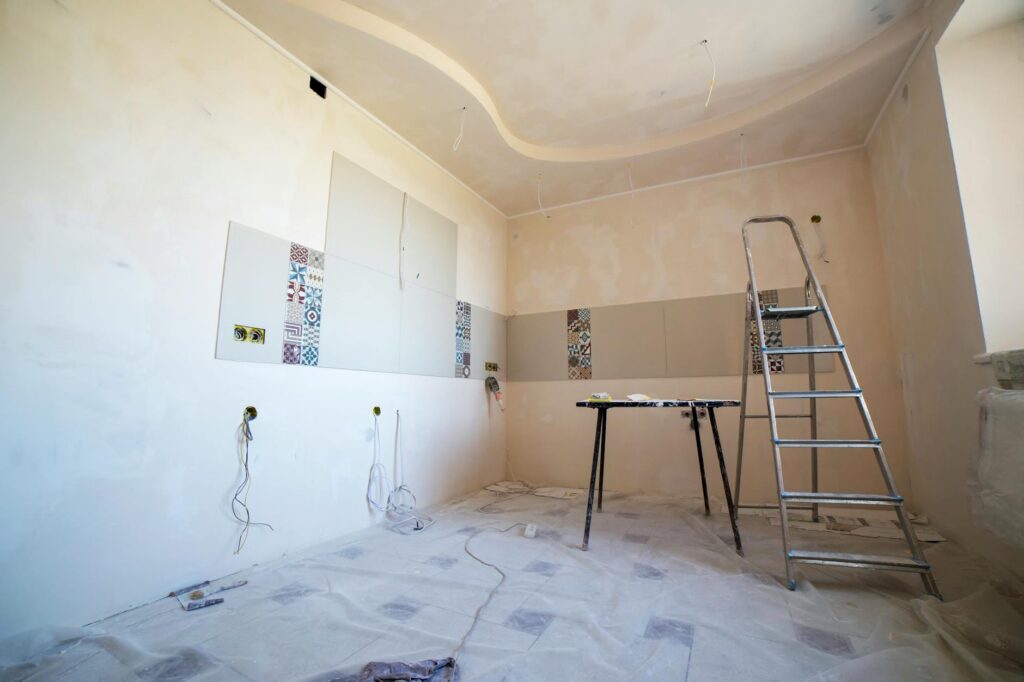
Calculating drywall needs depends on your room dimensions, not just square footage. To estimate accurately, measure all walls and ceiling areas, account for openings like doors and windows, and add 10% for waste. This guide walks you through calculating drywall requirements for any room in your home.
Understanding Drywall Sheet Sizes and Coverage
Standard drywall sheets come in common sizes: 4’x8′, 4’x10′, 4’x12′, and 4’x16′. The most popular choice is the 4’x8′ sheet, which covers 32 square feet. However, selecting the right size depends on your ceiling height and wall layout.
For 8-foot ceilings, 4’x8′ sheets are ideal—they fit perfectly with minimal waste. For 9-foot or 10-foot ceilings, 4’x10′ or 4’x12′ sheets reduce seams and labor time. Thicker sheets (5/8″) are better for soundproofing and fire resistance, while 1/2″ sheets work fine for standard residential applications.
Remember that drywall thickness also matters. Standard residential drywall is typically 1/2″ or 5/8″. The thicker option provides better sound dampening and fire rating but costs slightly more. Calculate your total wall and ceiling area first, then divide by your chosen sheet size to determine how many sheets you’ll need.
Room-by-Room Estimation Breakdown
Living Rooms and Bedrooms
For a standard 12’x14′ bedroom with 8-foot ceilings, start by calculating wall area. Add up all four wall dimensions: (12+14+12+14) x 8 = 416 square feet. Subtract 20 square feet per door (typically 3’x7′) and 10 square feet per standard window. If your room has two doors and two windows, subtract 60 square feet total, leaving 356 square feet of wall drywall needed.
For the ceiling, multiply length by width: 12 x 14 = 168 square feet. Combined wall and ceiling totals 524 square feet. Using 4’x8′ sheets (32 sq ft each), you’d need about 17 sheets. Always round up and add 10% for waste, bringing your total to approximately 19 sheets.
Bathrooms and Kitchens
Smaller rooms like bathrooms require careful window and fixture consideration. A 5’x8′ bathroom with 8-foot ceilings has wall area of (5+8+5+8) x 8 = 208 square feet. After subtracting one door (20 sq ft) and a small window (8 sq ft), you have 180 square feet. Add ceiling area (5 x 8 = 40 sq ft) for a total of 220 square feet, or about 7 sheets plus waste.
Kitchens often have more openings—cabinets, large windows, and doorways. Measure carefully and subtract these areas generously. A 10’x12′ kitchen might lose 80+ square feet to openings, significantly reducing material needs.
Basements and Large Spaces
Unfinished basements typically need drywall only on interior walls dividing spaces, not exterior foundation walls (which require moisture barriers first). Calculate perimeter walls and any partition walls you’re adding. Basement ceilings depend on whether you’re covering the joists or installing a suspended ceiling. If covering joists, treat it like any other ceiling and add 15% for waste since installations in basements often involve more complex layouts around mechanical systems.
Calculating Drywall with Different Ceiling Heights
Standard 8-foot ceilings align perfectly with 4’x8′ sheets placed horizontally, producing zero waste from height. However, rooms with vaulted, cathedral, or angled ceilings require additional calculations.
For vaulted ceilings, break the triangular section into manageable shapes. Measure the peak height and calculate the triangle’s area using the formula: (base × height) ÷ 2. Add this to your rectangular section above the walls to get total ceiling area.
Nine-foot ceilings create gaps below 4’x8′ sheets if hung horizontally. You can either use 4’x10′ sheets, or place 4’x8′ sheets vertically with a horizontal 4’x2′ strip above—the latter often wastes more material. For 10-foot or higher ceilings, 4’x12′ sheets are most efficient, though they’re heavier and require additional labor.
Always measure your actual ceiling height before ordering. Even small variations affect material calculations and installation difficulty. Pro tip: Take vertical measurements in multiple spots—older homes rarely have perfectly level ceilings.
How to Use the Calculator
Rather than manually calculating complex room dimensions, use our drywall calculator to instantly determine material needs. Input your room length, width, ceiling height, and number of doors and windows. The calculator automatically accounts for standard opening sizes, applies waste percentages, and provides sheet quantities based on your chosen drywall size.
This eliminates math errors and ensures you purchase the correct amount—not too little (requiring emergency trips) or too much (wasting money and creating storage problems).
FAQ
How much waste percentage should I add to drywall estimates?
Add 10% for straightforward rooms with standard layouts. Add 15% for complex spaces with many corners, angled ceilings, or numerous openings. Add 20% for intricate designs or if you’re a beginner (since learning curves increase mistakes). This accounts for cutting errors, damaged sheets during delivery or installation, and future repairs.
Should I buy drywall in 4×8, 4×10, or 4×12 sheets?
For 8-foot ceilings, 4’x8′ sheets are most economical with zero height waste. For 9-foot ceilings, 4’x10′ sheets reduce seams and labor. For 10-foot ceilings, 4’x12′ sheets are ideal but heavier and harder to install. Consider your ceiling height, skill level, and available help when choosing. 4’x8′ sheets are easier to handle solo, while larger sheets require two people.
Can I calculate drywall needs for angled or sloped ceilings?
Yes, but it’s more complex. Measure the slope’s length (not vertical height) and treat it like a rectangular wall section. For triangular areas created by peaks, measure the base width and peak height, then use the triangle area formula: (base × height) ÷ 2. Sketch your ceiling shape and break it into rectangles and triangles, calculate each section separately, then add them together. When uncertain, measure twice and add extra waste percentage.
Estimating drywall accurately saves time, money, and frustration during your project. Whether you’re finishing a basement, renovating a bedroom, or tackling a larger remodel, understanding your room dimensions and using proper calculation methods ensures you have exactly what you need—plus a little extra for mishaps.
- Drywall Taping Knives & Tools Set — Essential tools for anyone installing drywall, directly supporting the DIY project described in the post
- Drywall Square & T-Square Measuring Tool — Helps with accurate measurements and marking, which is critical for calculating drywall needs as emphasized in the guide
- Drywall Saw & Utility Knife Kit — Necessary cutting tools for fitting drywall around openings like doors and windows mentioned in the post
If you do work for others professionally, general liability insurance protects you from property damage and injury claims. Hiscox makes it easy to get covered.
Get a Free Hiscox Quote →
Affiliate disclosure: We may earn a commission if you get a quote through this link, at no cost to you.
Related: The Complete Drywall Calculator Guide: How Many Sheets for Your Room in 2026
Related: How to Calculate Square Footage for Any Room Shape
Related: Laminate Underlayment: 5 Types, Thickness & Do You Need It?