How to Measure Irregular Lawn Shapes for Sod or Seed
Measuring an irregular lawn shape doesn’t have to be complicated—you just need to break it down into simple geometric sections and calculate each area separately. Whether you’re installing sod or spreading seed, accurate measurements ensure you order the right amount of materials and avoid costly waste. This guide walks you through proven methods that any homeowner can master in an afternoon.
Breaking Down Your Lawn Into Geometric Shapes
The key to measuring irregular lawn areas is dividing them into manageable geometric shapes like rectangles, triangles, and circles. Start by sketching your lawn on paper or using a smartphone photo with grid lines. Look for natural boundaries—fences, driveways, garden beds—that naturally segment your space.
For most residential lawns, you’ll encounter a combination of rectangular sections (your main yard), triangular areas (corner lots, sloped sections), and possibly circular sections (around trees or islands). Mark each distinct shape with different colors on your sketch to keep track of them.
Once you’ve identified all shapes, you’ll measure each one separately using basic formulas. A rectangle requires length and width. A triangle needs the base and height. A circle needs the radius. The beauty of this method is that it transforms an intimidating irregular space into simple fifth-grade geometry.
Measuring Techniques and Tools You’ll Need
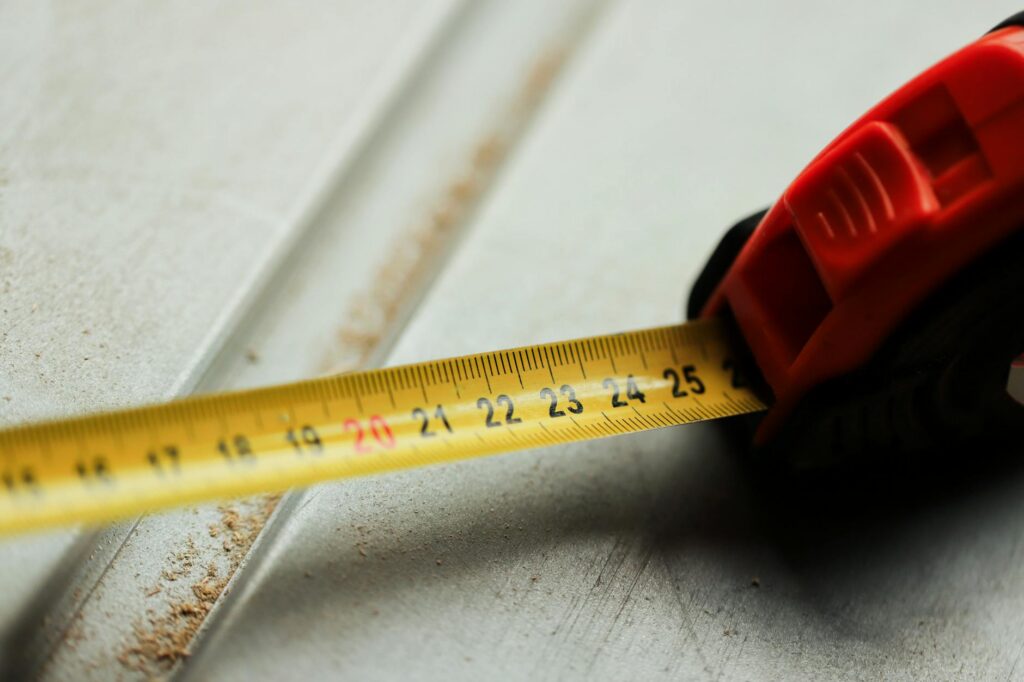
Start with basic tools: a 100-foot measuring tape (cloth or fiberglass works best for accuracy), stakes, string, and a clipboard with paper. Many experienced landscapers also use a smartphone measuring app, though a traditional tape measure remains most reliable.
For rectangular sections, measure the length along one side and the width perpendicular to it. Take multiple measurements across longer distances to account for slight variations—use the average if numbers differ. Always measure from the same reference point (like your house foundation) to maintain consistency.
For triangular areas, measure along the longest side (the base) and then measure the perpendicular distance from that base to the opposite point (the height). This sounds complex but is straightforward once you stretch a string along the base and measure straight out to the farthest corner at a 90-degree angle.
For circular or curved sections around trees or garden features, locate the center point and measure the distance to the edge (radius). If the feature isn’t perfectly circular, measure the widest and narrowest points, average them, and divide by two for your radius.
Pro tip: Don’t estimate “close enough.” Sod costs money, and underestimating means extra trips to the supplier. Overestimating by 5-10% is acceptable as cushion; overestimating by 30% wastes significant funds.
Converting Measurements to Coverage Area
After measuring each section, you’ll calculate area using these basic formulas:
Rectangle: Length × Width = Area (in square feet)
Triangle: (Base × Height) ÷ 2 = Area (in square feet)
Circle: Radius × Radius × 3.14159 = Area (in square feet)
Write down each calculation as you go. For example, if your main yard is 50 feet long and 40 feet wide, that’s 2,000 square feet. If you have a triangular corner lot that’s 20 feet at the base and 15 feet at the height, that’s 150 square feet.
Add all sections together for your total lawn area. This final number is what you’ll use when ordering sod rolls or seed bags. Most sod comes in rolls covering 10 square feet, and seed bags specify their coverage area on the label.
If your calculations show 4,500 total square feet, you’d need 450 rolls of sod (4,500 ÷ 10). Always round up to the nearest whole number and add 5-10% extra for cutting, waste, and future repairs.
Use Our Lawn Area Calculator for Accuracy
While manual calculations work perfectly fine, you can streamline the process and double-check your math using our lawn area calculator. Simply input your measurements for each geometric section, and the calculator instantly provides your total coverage area. This eliminates arithmetic errors and saves time, especially for complex yards with multiple sections.
FAQ: Measuring Irregular Lawn Shapes
What if my lawn has curved edges instead of straight lines?
Curved edges are common along flower beds and walkways. For gentle curves, approximate them as straight lines between the two endpoints—this gives you sufficient accuracy for ordering materials. For more dramatic curves, divide the curved section into multiple smaller geometric shapes. For example, a curved garden bed might be broken into two or three small triangles that together approximate the actual curve. This method adds slight extra area but provides good coverage accuracy.
Should I include areas with shade, thatch, or existing bare spots?
Yes, measure your entire lawn space that needs sod or seed, even if grass currently grows unevenly there. You’re measuring the area to be covered, not the area with healthy grass now. If you’re replacing patchy grass with fresh sod, measure the complete lawn. If you’re overseeding bare spots, measure just those problem areas separately and add them to your main measurement.
How accurate do my measurements need to be?
Within 5% is excellent for residential lawns. Within 10% is acceptable and standard in the landscaping industry. Don’t obsess over exact precision—nature rarely creates perfect geometric shapes. The goal is getting close enough to order the right quantity without massive overage or shortage. If your calculations show 4,500 square feet, ordering 4,725 square feet worth of materials (5% extra) is smart practice and protects against measurement variation.
- Digital Laser Measuring Tape — Essential tool for accurately measuring irregular lawn dimensions and distances without manual errors
- Grass Seed Spreader — Directly applicable for users who choose to seed their lawn after measuring and calculating the correct coverage area
- Sod Cutter Rental or Tool — Relevant for users preparing their lawn area before installing sod, following the measurement process outlined in the post
Related: Sod Calculator: Measure Your Lawn and Order With Confidence