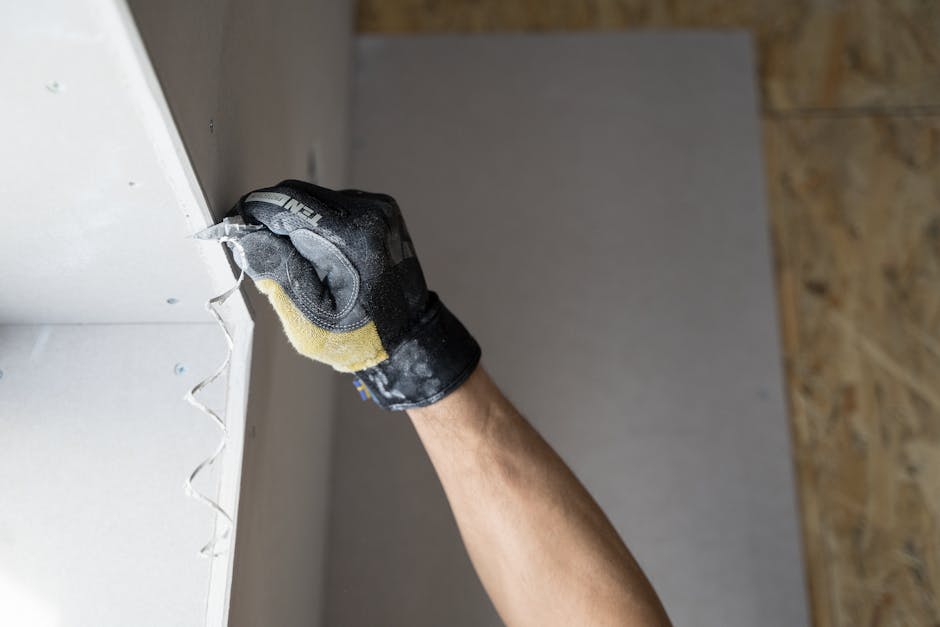
To calculate drywall sheets needed, measure your room’s wall area in square feet, then divide by 32 (for 4×8 sheets) or 48 (for 4×12 sheets). Add 10% extra for waste. For mudding and taping, expect $0.50–$1.50 per square foot in labor costs depending on finish quality.
How to Calculate Drywall Sheets Needed
Getting the right amount of drywall is critical for any renovation project. I’ve learned this the hard way—ordering too little means extra trips to the supplier, while ordering too much wastes money and storage space.
The calculation is straightforward once you understand the basics. First, measure all wall areas you plan to cover in square feet. Include height and width dimensions, then multiply them together. For example, a wall that’s 10 feet wide and 8 feet tall equals 80 square feet.
Standard drywall sheets come in two common sizes:
- 4×8 sheets: 32 square feet per sheet
- 4×12 sheets: 48 square feet per sheet
Once you have your total wall area, divide by the sheet size you’re using. If your room totals 400 square feet and you’re using 4×8 sheets, you’d need 12.5 sheets (400 ÷ 32 = 12.5).
Here’s the critical part: always add 10% for waste. Drywall requires cuts around windows, doors, and corners. This waste factor accounts for mistakes, damaged sheets, and awkward angles. So 12.5 sheets × 1.10 = 13.75 sheets. Round up to 14 sheets.
This methodology aligns with industry standards used by professional contractors nationwide. Having that extra material prevents expensive delays and ensures you can match existing material if repairs become necessary.
How many drywall sheets do I need for a 12×12 room?
A 12×12 room with 8-foot ceilings has four walls. Two walls are 12 feet wide by 8 feet tall (96 sq ft each), and two walls are 12 feet wide by 8 feet tall (96 sq ft each). That’s 384 square feet total. Using 4×8 sheets: 384 ÷ 32 = 12 sheets. Add 10% waste: 12 × 1.10 = 13.2, so you need 14 sheets.
Drywall Taping and Mudding Cost Estimate
Once your drywall is installed, the taping and mudding phase begins. This is where finishing quality makes all the difference in your final result. According to industry data, labor costs for drywall finishing typically range from $0.50 to $1.50 per square foot, depending on the finish quality you’re targeting.
Let me break down what drives these costs:
Finish Quality Levels:
- Level 1 (basic): $0.50–$0.75/sq ft. Tape and mud applied, minimal finishing. Used for areas hidden by cabinets or behind equipment.
- Level 2 (standard): $0.75–$1.00/sq ft. More careful taping with initial coat finish. Suitable for garages and utility spaces.
- Level 3 (quality): $1.00–$1.25/sq ft. Multiple coats with light sanding between applications. Standard for most residential rooms.
- Level 4 (premium): $1.25–$1.50/sq ft. Heavy-duty finishing with skim coating for flawless appearance under paint.
What is the average cost of drywall mud and tape per square foot?
For residential projects with standard finish quality (Level 3), most homeowners pay between $1.00 and $1.25 per square foot for labor. Material costs (mud, tape, joint compound) typically add another $0.10–$0.20 per square foot. So a 400-square-foot room finishes at roughly $400–$500 in labor plus $40–$80 in materials.
Regional variations exist. Urban markets tend toward the higher end, while rural areas may be lower. The complexity of your walls—lots of angles, windows, and doors—also increases costs since it requires more detailed work.
Drywall Calculator Tool
Using a dedicated drywall installation calculator removes the guesswork from your project planning. These tools let you input your room dimensions and automatically calculate sheet requirements with waste factored in.
The best calculators also account for:
- Different sheet sizes (4×8, 4×12, or custom)
- Ceiling height variations
- Window and door openings
- Waste percentage adjustments
I recommend entering your measurements twice to verify accuracy. A simple data entry error can result in ordering significantly too much or too little material.
For larger projects, consider using our cost estimation calculator to budget for both materials and labor across your entire renovation. This comprehensive approach helps you track expenses as your project progresses.
Tips for Accurate Drywall Measurements
Precision in measurement prevents costly mistakes. Here’s what I’ve learned from managing renovation projects:
Measure from floor to ceiling in multiple locations. Older homes often have uneven ceilings. If your ceiling ranges from 7’10” to 8’2″, use the longest measurement to ensure adequate coverage.
Account for obstacles carefully. When calculating around windows and doors, measure the opening dimensions and subtract from your total wall area. For a standard 3×4 window opening, subtract 12 square feet from that wall’s total.
Mark irregular areas. Sloped ceilings, soffits, and architectural features require additional sheets. Sketch these areas and calculate their square footage separately.
Verify your math before ordering. Double-check your calculations or use an online calculator to confirm quantities. The cost of verification is minimal compared to ordering mistakes.
Consider future repairs. Buy one or two extra sheets beyond your calculated amount. Storing these allows you to patch damage years later with matching material.
Frequently Asked Questions
How long does drywall mud take to dry between coats?
Standard drywall joint compound typically dries in 24 hours between coats under normal conditions (68–75°F with 30–50% humidity). Cold or humid environments extend drying time to 48 hours or more. Always allow adequate drying time before sanding or applying the next coat to achieve the best finish quality.
Can I install drywall myself or should I hire professionals?
Drywall installation is physically demanding but achievable for DIYers. Hanging sheets requires careful alignment and proper fastening. Taping and mudding is more technique-dependent—the finishing work determines whether your walls look professional. Many homeowners install themselves but hire professionals for the finishing phase to ensure quality results.
What’s the difference between drywall and plasterboard?
Drywall and plasterboard are essentially the same product—a gypsum core sandwiched between paper layers. The terms are used interchangeably in North
- Drywall Sheets (4×8 ft) – Amazon Basics — Direct product match for the main calculation topic; users actively calculating drywall needs will likely want to purchase sheets
- Drywall Taping & Mudding Tool Kit — Complements the post’s discussion of mudding and taping costs; DIY users may want tools to handle finishing work themselves
- Drywall Square & Measurement Tools — Essential for accurately measuring room dimensions mentioned in the calculation methodology; practical tool for implementing the guide
Related: The Complete 2026 Drywall Calculator Guide: Sheets, Costs & Mudding Estimates
Related: Drywall Calculator: Sheets, Tape, and Mud Quantities Explained