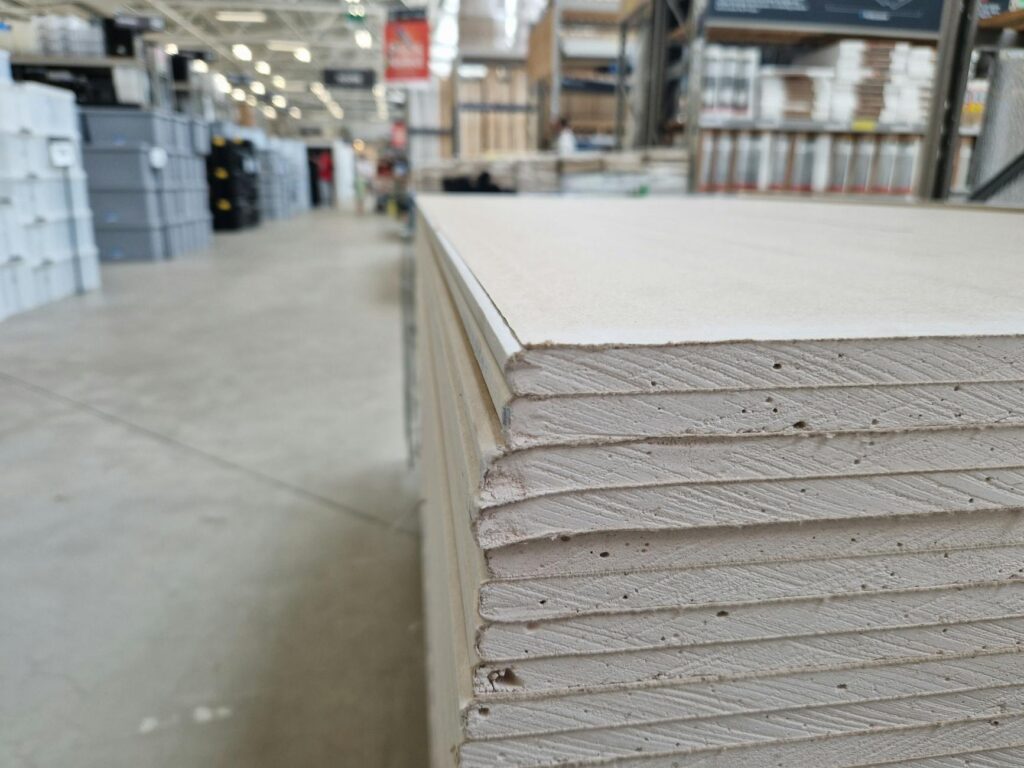
Calculating drywall materials correctly is essential for any wall or ceiling project, ensuring you buy the right amount of drywall sheets, joint tape, and compound without waste or shortages. This guide breaks down how much drywall, tape, and mud you need based on your project’s square footage and helps you understand the material requirements for a professional finish.
Understanding Drywall Sheet Requirements
Drywall sheets come in standard sizes, most commonly 4 feet wide by 8, 10, 12, or 16 feet long. The most popular choice is the 4×8 sheet, which covers 32 square feet. To calculate the number of sheets needed, divide your total wall or ceiling square footage by 32.
For example, if you’re finishing a room with 800 square feet of wall space, you’d need approximately 25 sheets (800 ÷ 32 = 25). However, you should always add 10-15% extra for waste, cuts, and mistakes. This means ordering about 28-29 sheets for that 800 square foot project.
Consider your project layout when calculating sheets. Vertical or horizontal orientation affects material efficiency. For most residential projects, installing sheets horizontally (perpendicular to studs) minimizes the number of horizontal joints and reduces taping work. Measure your wall heights and widths carefully, accounting for door and window openings, as these reduce the amount of drywall needed but increase the complexity of cutting.
The thickness of drywall matters too. Standard residential drywall is 1/2 inch thick for walls and 5/8 inch for ceilings or fire-rated applications. Thicker drywall provides better sound dampening and fire resistance but costs more. Most DIYers use standard 1/2-inch drywall for interior walls.
Calculating Joint Tape and Compound Needs
Joint tape and joint compound (mud) go hand-in-hand for finishing drywall seams. The amount you need depends on the linear feet of joints in your project. Every seam where two drywall sheets meet requires taping.
Joint tape comes in two types: paper tape and mesh tape. Paper tape is stronger for butt joints and inside corners, while mesh tape works well for flat joints and outside corners. A standard roll of joint tape is 300-500 feet long. To estimate your needs, measure all seams (vertical and horizontal), then multiply by 1.1 to account for overlap at corners and mistakes.
Joint compound, or “mud,” is applied in three coats: the first “fill” coat embeds the tape, the second “finish” coat provides coverage, and the third “sand” coat creates a smooth surface. A standard 5-gallon bucket of all-purpose joint compound covers approximately 100-150 square feet per coat, depending on application thickness and technique.
As a general rule, for every 100 square feet of drywall:
- Use 100 linear feet of joint tape
- Apply approximately 1.5 gallons of joint compound for all three coats
- Plan for 2-3 buckets of compound for a full project (most DIYers end up using slightly more than expected)
Pre-mixed joint compound is convenient but heavier and more expensive per use than powder compound you mix yourself. For larger projects over 500 square feet, powder compound is more economical. However, powder compound requires water and mixing equipment.
Material Waste and Overage Factors
Professional drywall installers expect 10-15% waste on sheets due to cutting, breakage, and fitting around obstacles. For compound and tape, overage is typically 5-10% because these materials are easier to use partially.
Several factors increase material needs beyond basic calculations:
- Complex layouts: Rooms with many corners, alcoves, or architectural features require more tape and additional compound for detailed work.
- Texture or finishing: If you plan textured walls or popcorn finishes, you’ll need additional compound beyond standard three-coat applications.
- Repair work: Patching existing drywall around new installations requires extra supplies.
- Quality finish: Aiming for a high-quality finish typically requires more compound for additional sanding and touch-up coats.
Store joint compound in a cool, dry location. Unopened buckets last approximately one year, while powder compound stays viable for several years if kept dry. Opened buckets should be sealed tightly and used within a few months to prevent hardening.
How to Use the Drywall Calculator
Rather than manually calculating material quantities, use a dedicated drywall calculator to save time and reduce errors. Input your project dimensions—total square footage of walls and ceilings—and the calculator instantly provides quantities for sheets, tape, and compound with built-in waste factors.
For precise material planning, also consider using our square footage calculator to measure your room dimensions accurately before entering data into the drywall calculator. Accurate measurements are the foundation of correct material estimates.
A quality calculator shows material needs broken down by type, helping you understand what you’re purchasing and why. Many calculators also display cost estimates if you input material prices, helping you budget for the entire project.
Frequently Asked Questions
How much does drywall compound shrink as it dries?
Joint compound shrinks approximately 12-15% as it dries, which is why multiple coats are necessary. The first coat shrinks noticeably, creating depressions along seams. Subsequent coats fill these depressions. This shrinkage is normal and expected—using thinner coats that dry completely between applications minimizes visible shrinkage and produces better results than one thick coat.
Can I use drywall compound for ceiling work?
Yes, all-purpose joint compound works on ceilings, but it’s more challenging because gravity pulls wet compound downward. Lightweight or “easy sand” compounds are better for ceilings because they’re less dense and easier to apply overhead. Some professionals prefer setting-type compound for ceiling work because it hardens quickly and resists sagging. Whatever compound you choose, work in thin coats and allow proper drying time between applications.
What’s the difference between all-purpose and taping compound?
All-purpose compound is a general-use product suitable for all three coats in standard applications. Taping compound has a shorter drying time and stronger adhesion, making it ideal for the first coat that embeds tape. Finishing compound is lighter and sands more smoothly for the final coat. Most DIYers stick with all-purpose compound for simplicity, though professionals often use specialized compounds for each stage. The difference in quality is noticeable on high-end finishes but minimal for typical residential projects.
Related: shed building cost guide
Related: DIY calculator guide
Related: concrete calculator guide
Related: wood vs composite deck costs
Related: deck building cost guide
Related: concrete project cost estimator
- USG Sheetrock Brand Drywall Sheets — Directly addresses the primary material discussed in the calculator – essential for users planning drywall projects
- Drywall Taping Tape & Joint Compound Combo — Covers the tape and mud materials that are core components of the calculator, providing convenience for project planning
- Drywall Tools Set (Putty Knives, Taping Knives, Sander) — Complements material purchasing with the application tools needed to complete drywall projects calculated by the tool
If you do work for others professionally, general liability insurance protects you from property damage and injury claims. Hiscox makes it easy to get covered.
Get a Free Hiscox Quote →
Affiliate disclosure: We may earn a commission if you get a quote through this link, at no cost to you.
Related: Ceiling Drywall Installation: Weight, Fasteners & Quantities